Louis Vuitton, Singer drive Porsche 911 into desert
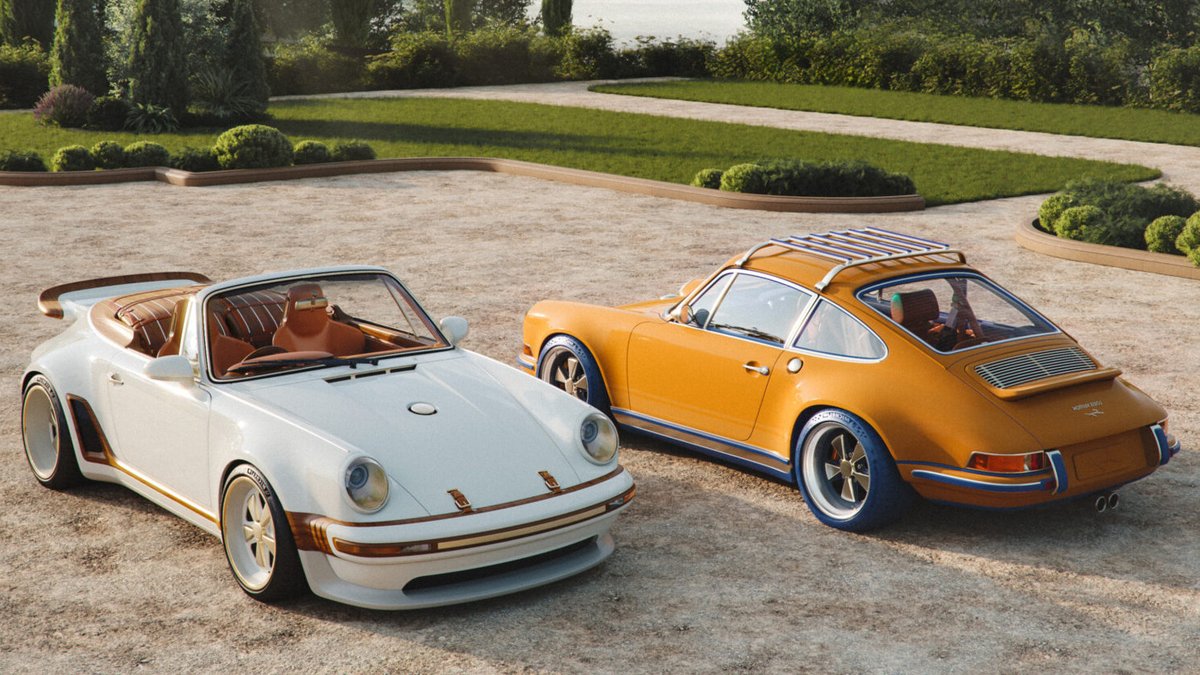
At Monterey Car Week 2026, the automotive world saw a rare melding of high fashion and classic sports engineering as Singer Vehicle Design and Louis Vuitton unveiled two uniquely styled Porsche 911 models.
Singer and Louis Vuitton debut two reimagined Porsche 911s
The partnership produced a coupe dubbed “Classic” and a turbocharged cabriolet called “Classic Turbo.” Both vehicles carry the fashion house’s signature saffron, cobalt blue and yellow palette, but each follows a distinct design narrative.
“We were constantly exchanging ideas, with an enormous volume of renderings, digital design data, paint, and leather samples, and then photographs of the cars as they evolved,” said Rob Dickinson, founder and executive chairman of Singer. “Our two houses brought different expertise to the project, but we share the same standards and the same ambition.”
Related: Valspar Declares 2027 Blue as New Neutral
The collaboration began modestly when a Singer client requested a Louis Vuitton clock for a car interior. The request grew, according to chief strategy officer Mazen Fawaz, into a full‑scale effort that “extended to encompass every element of the car.”
Work shuttled between Paris, California and England, with designers, engineers and artisans coordinating across time zones. The process spanned roughly a year, during which the instrument panel was redesigned to integrate a removable mechanical clock inspired by the brand’s Tambour watch.
Inside the Classic coupe, natural‑toned leather mirrors the cowhide used in Louis Vuitton luggage, while yellow stitching and diamond embossing echo the brand’s leather goods. Metal switches replace typical plastic components, a nod to watchmaking precision.
Outside, the saffron bodywork is paired with cobalt blue accents and a specially engineered roof rack that can carry luggage, skis, or a surfboard, recalling Louis Vuitton’s historic automobile‑specific trunks dating back to the late 19th century.
Related: Lamborghini Unveils Stroller for Infants
For the turbocharged cabriolet, artistic director Nicolas Ghesquière guided a nautical aesthetic. The white “Calcaire Lutétien” finish, wood‑trimmed bumpers and a varnished rear deck recall classic motorboats, while a lightweight roof suggests a sail.
In the cabin, a central console houses the clock, and the gauges were redesigned to match the visual language of the instrument panel, complementing the natural‑toned leather.
The effort highlights the shared focus on craftsmanship, art and engineering that both companies claim as core to their identity.

Valspar Declares 2027 Blue as New Neutral


